

I came across a fascinating paper, ‘A progression model of software engineering goals, challenges, and practices in start-ups’, that analyzed 84 software startups across different stages. The key insight? Traditional Software Engineering practices weren’t designed for the reality of rapid evolution, small teams, and extreme uncertainty that defines startup life.
What struck me most was how dramatically engineering priorities must shift as startups evolve from Inception → Stabilization → Growth → Maturity. Getting this wrong at any stage can be the difference between thriving and merely surviving.
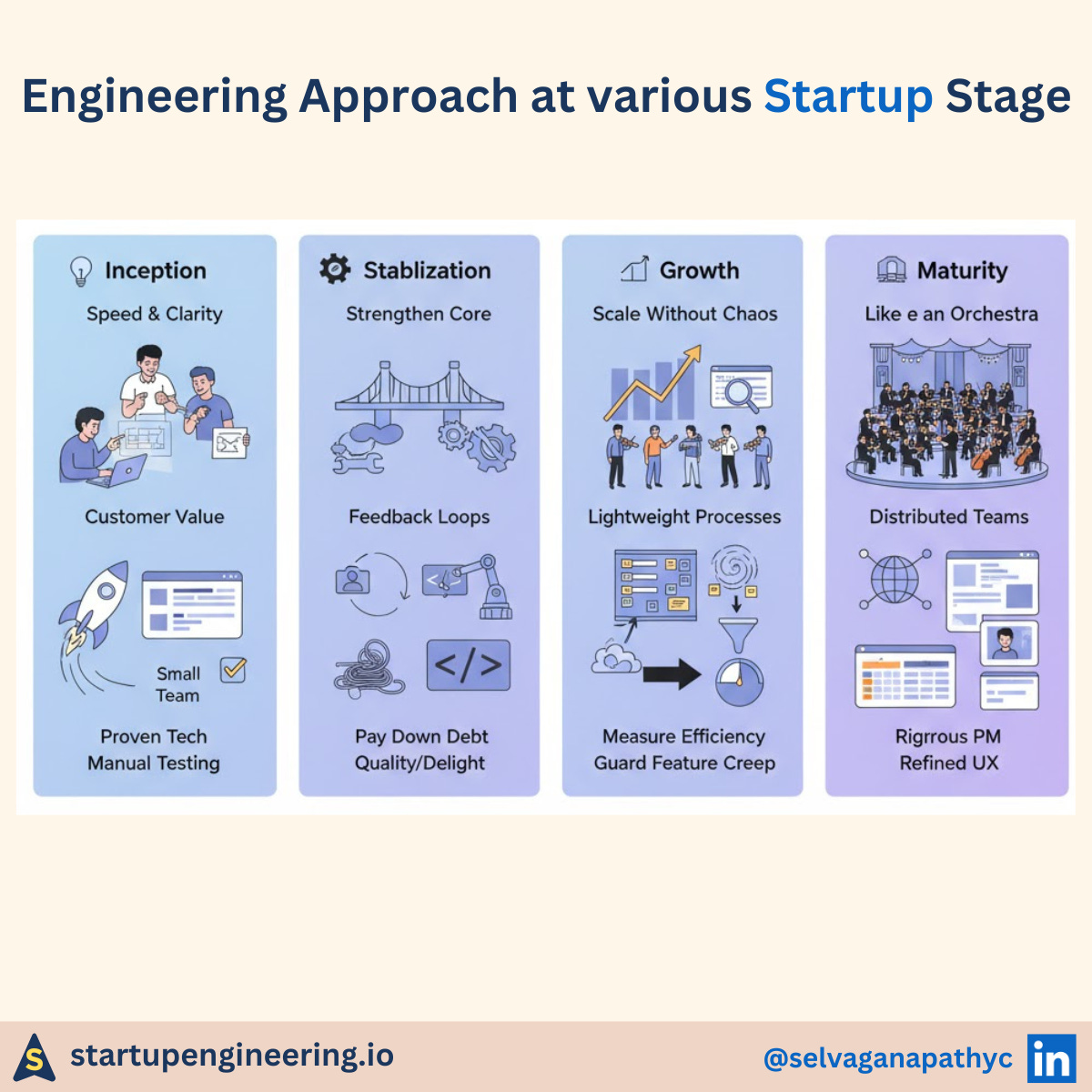
Here’s what great startup teams do differently at each stage:
Inception: Build with speed and clarity
The Reality: You’re racing to build your first release before running out of runway. But speed without focus kills startups just as surely as perfectionism does.
What Matters Most:
Assemble the right 2-4 person team – The study found that team capability matters more than team size. You need domain knowledge AND engineering expertise. One without the other leads to either building the wrong thing well, or the right thing poorly. If you’re missing skills, consider targeted outsourcing rather than hiring too early.
Invented requirements need rapid validation – At this stage, 90% of your product ideas are invented, not discovered. Your job isn’t to build everything you imagine—it’s to invalidate your assumptions as quickly as possible with real users. Use mockups and prototypes, not production code, for validation.
Scope your MVP ruthlessly – The most common mistake? Building features that won’t validate your core hypothesis. Ask: “Does this feature test our value or growth hypothesis?” If not, kill it. One startup in the study reflected: “Any requirement essential for validating the hypotheses is priority. Anything to support the business when the user base is larger than 100 users is not a priority.”
Choose boring technology – 67% of startups in the study used established, stable frameworks rather than cutting-edge tech. Why? Mature technologies have communities, documentation, and fewer surprises. Save your innovation budget for your product, not your infrastructure.
Keep testing manual but systematic – Automated testing can wait. But manual testing shouldn’t mean random clicking. Use informal exploratory testing with clear scenarios. It’s faster to set up and more valuable when requirements change daily.
The Hidden Trap: The biggest danger at inception isn’t moving too slowly—it’s building with too many people or without clear accountability. The study found a significant association between closed companies and lack of team accountability. Stay small, stay focused, stay aligned.
Stabilization: Strengthen the core
The Reality: You’ve launched. You have early customers. Now comes the hard part—evolving the product without collapsing under technical debt while your team is still tiny.
What Matters Most:
Establish your customer feedback loop – This is THE defining practice of this stage. The data is stark: 91% of active startups actively collected customer input, versus only 43% of closed startups. Set up regular customer interviews, usage analytics, and support ticket reviews. Make customer input directly drive your product roadmap.
Fight feature creep relentlessly – With customer feedback flowing in, you’ll be tempted to build everything everyone asks for. Don’t. 30% of startups at this stage fell into the feature creep trap, draining resources and adding complexity. Use the Pareto principle: only build features that 80% of customers will use. Everything else is a distraction.
Document requirements—even informally – You can’t keep everything in your head anymore. Write down feature ideas, their source, and rationale. Even simple Trello cards beat relying on memory. This isn’t bureaucracy—it’s building organizational knowledge as your team grows.
Define “good enough” quality explicitly – You can’t afford perfect, but you can’t afford broken either. Startups that succeeded were deliberate about quality thresholds. One stated: “We look for the simplest solution that can support a couple hundred users. How can it be improved to support more?” Set clear minimum bars for performance, reliability, and UX.
Start addressing technical debt strategically – Architecture decisions that worked for 10 users will break at 1,000. The study found that teams with adequate skills were more likely to recognize and address technical debt early. Review your architecture quarterly. Budget 15-20% of engineering time for refactoring the most painful areas.
The Hidden Trap: Scaling your product before scaling your team processes. Teams that jumped from 3 to 10 people without establishing clear responsibilities, communication norms, and decision-making processes hit serious coordination challenges. Invest in team structure now, before it becomes crisis management.
Growth: Scale without chaos
The Reality: You’re no longer just building—you’re operating, supporting, selling, and iterating simultaneously. Engineering decisions now directly impact revenue, and business goals directly impact your roadmap.
What Matters Most:
Balance customer value with business goals – This is where value definitions shift. It’s no longer just about what users want—it’s also about monetization, market expansion, and differentiation. One startup noted: “We prioritize using this question: how much money or new customers will we gain if we implement this feature?” Engineering must have a seat at the business strategy table.
Make metrics non-negotiable – 80% of growth-stage startups tracked both external metrics (revenue, customer satisfaction, usage) and internal metrics (team velocity, deployment frequency, bug rates). Without metrics, you’re flying blind. Implement basic analytics, error tracking, and performance monitoring. Review metrics weekly with the entire team.
Hire for specialist skills strategically – 80% of growth-stage startups reflected on needing specialist skills (specific domain expertise, advanced technical skills, security experts). But hiring too many specialists too fast creates coordination overhead. Hire specialists for force-multiplier roles—someone who can uplevel your entire team, not just do specialized tasks.
Invest in test automation NOW – Manual regression testing becomes unsustainable at this stage. The study found growth-stage teams spending substantial effort manually testing the entire product before releases. Automate your most painful regression tests first. Start with smoke tests, then expand. Even 30% test automation dramatically accelerates releases.
Address technical debt aggressively – Technical debt peaks at the growth stage and becomes a major velocity killer. Architecture debt is particularly insidious—one startup reflected: “Initially, the product was started by an inexperienced developer and many design decisions were incorrect. Fixing them early would have been easy, however with the product and user base growing, changing core things became increasingly difficult.” Allocate 20-30% of engineering time to paying down the most critical debt.
The Hidden Trap: Treating growth as purely a sales/marketing problem. The study found that engineering bottlenecks—slow releases, poor quality, inability to support multiple customer segments—often capped growth more than market factors. Engineering infrastructure must scale ahead of demand, not react to it.
Maturity: Operate like an orchestra
The Reality: You’re no longer a plucky startup—you’re a real software company with distributed teams, complex deployment pipelines, and enterprise customers. Your engineering practices need to reflect that maturity.
What Matters Most:
Formalize project management without killing agility – 87% of mature startups had established project management processes with tools, sprint planning, and resource planning. But these weren’t heavyweight waterfall processes—they were lightweight frameworks that brought visibility without bureaucracy. Implement structured sprints, clear roadmaps, and capacity planning. Use tools like Jira or Linear, but keep ceremonies minimal.
Establish a dedicated QA function – Manual testing by engineers doesn’t scale to large, complex products. Mature startups introduced QA specialists or QA teams responsible for test strategy, automation, and quality gatekeeping. This frees engineers to focus on building while maintaining quality.
Build for portability and multi-tenancy – As you expand to new markets or customer segments, your architecture must support multiple configurations, languages, compliance requirements, and deployment models. Portability wasn’t a concern at earlier stages but becomes critical now. Design for configuration, not customization.
Optimize for team coordination, not individual productivity – With 20+ person teams, often distributed, communication and coordination become the bottleneck. Mature startups invested in documentation, clear interfaces between components, and structured handoffs. Architecture decisions should minimize dependencies between teams.
Measure and optimize team performance – Mature startups tracked internal efficiency metrics: deployment frequency, lead time for changes, time to restore service, change failure rate (the DORA metrics). These metrics reveal organizational bottlenecks that individual productivity measures miss.
The Hidden Trap: Assuming maturity means slowing down. The best mature startups maintained startup speed through better processes, not despite them. They used automation, clear ownership, and disciplined prioritization to move faster than their younger competitors while maintaining higher quality.
The Meta-Lesson: Evolution is the Only Constant
The most striking finding from the study wasn’t about any single stage—it was about the dramatic shifts between stages. What makes you successful at inception (small team, invented requirements, manual everything) will break you at growth. What’s premature at stabilization (formal QA, extensive metrics) becomes essential at maturity.
The startups that succeeded were those that recognized these shifts and deliberately evolved their practices. The startups that failed often got stuck applying inception-stage practices to growth-stage problems, or prematurely optimizing at inception for maturity-stage needs.
Three practices that matter at every stage:
Customer connection – From inception to maturity, maintaining direct customer feedback loops correlated with success. Never let processes get in the way of listening.
Deliberate quality decisions – Whether defining your MVP scope or enterprise SLAs, explicitly deciding what quality means prevented both under-engineering and over-engineering.
Team capability over process – At every stage, teams with strong domain knowledge and engineering skills could compensate for immature processes. Skills matter more than frameworks.
The question isn’t “What are the best software engineering practices?” The question is “What are the right practices for our stage, and how do we know when to evolve?”
The startups that answer that question thoughtfully are the ones that survive to maturity—and beyond.
The paper analyzed 84 software startups across Europe and South America, using case survey methodology to identify patterns in engineering goals, challenges, and practices. The full citation: Klotins et al., “A progression model of software engineering goals, challenges, and practices in start-ups,” Journal of LaTeX Class Files, 2014.
What stage is your startup at? What engineering practices are working—and which ones are holding you back? Reply and let me know—I read every response.