

They’ll be the best orchestrators.
This is the single biggest shift in Anthropic’s 2026 Agentic Coding Trends Report — and most startup engineering teams aren’t ready for it.
For years, engineering value was measured by how much you could build.
Lines of code shipped. Features delivered. PRs merged.
That metric is dying.
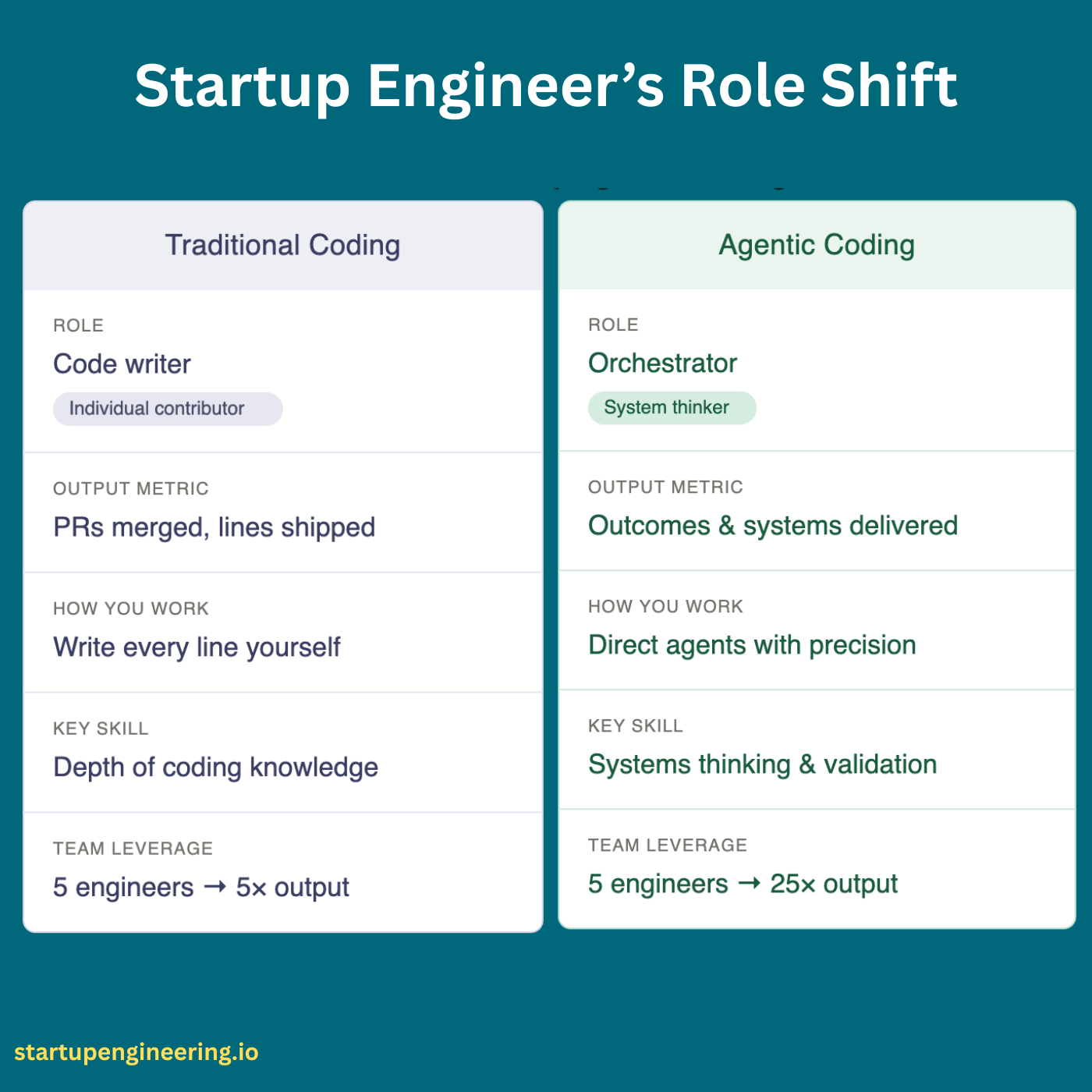
Here’s what’s actually happening right now:
Agents can complete 20 autonomous actions before needing human input. Six months ago, that number was 10. The trajectory is clear.
The engineer who keeps their head down writing every line of code isn’t your most valuable engineer anymore.
The engineer who knows how to direct agents — precisely, efficiently, safely — is.
For enterprise teams with 200 engineers, this is a restructuring problem.
For startup engineering teams, this is a superpower.
A 5-person startup team that orchestrates agents well doesn’t just punch above its weight.
It punches like a 25-person team.
So what does the “orchestrator mindset” actually look like in practice?
It’s three things:
1. Define roles with precision, not prompts Stop asking agents to “build a feature.” Start defining them like team members — this agent owns the schema, this one writes the API, this one runs security checks. Ambiguity in a prompt wastes hours. Precision in a role definition multiplies output.
2. Set guardrails before you set them loose What can the agent decide autonomously? What must come back to a human? The teams winning with agentic engineering aren’t the ones giving agents the most freedom. They’re the ones who’ve drawn the clearest lines. Autonomy within constraints — that’s the startup engineering way.
3. Your job is validation, not generation You’re no longer the person writing the code. You’re the person who catches what the agent gets wrong, spots the architectural drift, and makes the calls that require real-world judgment. That’s a higher-leverage role — if you embrace it.
Here’s what I’ve seen firsthand:
In the last 8 months leading a 14-person AI engineering team at a startup, the engineers who adapted fastest weren’t the ones with the deepest coding skills.
They were the ones who could think in systems. Who could break a problem into agent-sized pieces. Who could review output with a sharp eye and move on.
The mindset shift happened before the tools did.
Startup engineers have always done more with less.
We’ve always had to think in systems because we couldn’t afford to throw bodies at problems.
We’ve always had to ship with constraints because runway doesn’t wait.
Agentic coding didn’t change our game.
It just made our game worth 10x more.
The engineers who will define the next decade of startup engineering aren’t learning to code faster.
They’re learning to orchestrate smarter.