

I spent the last few weekends building an AI agent system. Here’s the architecture that actually makes sense.
After experimenting with different patterns and reading countless papers, I’ve settled on a layered architecture that balances simplicity with production-readiness.
Why I built this:
Most agent architectures I found online were either:
• Too academic (great for papers, terrible for building)
• Too simplistic (demos that break at scale)
• Too enterprise grade (over engineered for Startups)
So I designed something practical for Startups
The Four-Layer Approach:
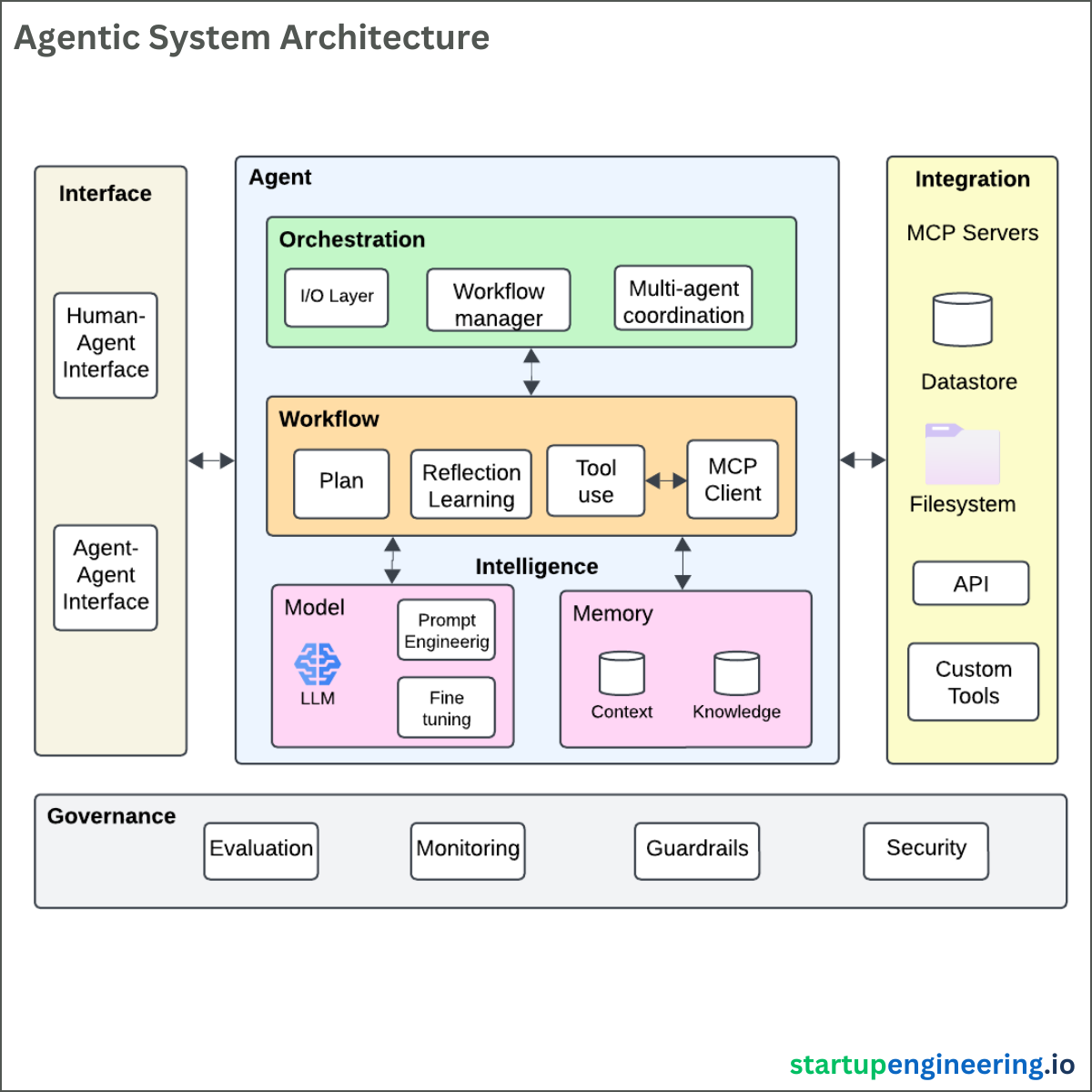
1. Interface Layer - Multiple Entry Points
• Human-Agent: Standard chat interface
• Agent-Agent: For multi-agent collaboration
2. Agent Layer - The Core System
This is where it gets interesting. Three distinct sub-layers:
2.1 Orchestration (Coordination)
• I/O Layer for all data flow
• Workflow Manager for process control
• Multi-agent coordination for scaling
2.2 Workflow (Execution)
• Plan: Break down complex tasks
• Reflection Learning: Continuous improvement
• Tool Use ↔ MCP Client: Execute with external tools. MCP (Model Context Protocol) standardizes how agents connect to external systems. No more writing custom integrations for every API.
2.3 Intelligence (Cognition)
• Model: LLM with prompt engineering and fine-tuning
• Memory: Context (short-term) + Knowledge (long-term)
This separation lets the agent remember conversations while building institutional knowledge over time.
3. Integration Layer - External World
MCP Servers provide standardized access to:
• Datastores
• Filesystems
• APIs
• Custom tools
4. Governance Layer - The Difference Between Demo and Production
This is what everyone skips. Don’t.
• Evaluation: Measure quality
• Monitoring: Track performance and costs (yes, costs matter!)
• Guardrails: Prevent harmful outputs
• Security: Protect sensitive data
For engineering teams: This layer saves debugging hours and prevents costly production issues. Build it from day one.
Key Insights from Building This:
1. Reflection Learning is your competitive advantage
2. MCP changes everything
3. Memory architecture matters more than model choice
4. Governance isn’t optional
5. Multi-agent coordination unlocks scale
What I’d Do Differently:
Don’t: Build custom tool integrations
Do: Use MCP from the start (saved weeks)
Don’t: Fine-tune immediately
Do: Perfect your prompts first (70% cost reduction before considering fine-tuning)
Don’t: Skip the Reflection component
Do: Let your system learn from every run (this is your moat)
Don’t: Treat Memory as an afterthought
Do: Design it early - it’s harder to retrofit
Don’t: Build without monitoring
Do: Track costs, latency, and success rates from day one